A real-world guide to planning and selecting mobile coffee catering, based on thousands of drinks served at corporate conferences, luxury automotive events, retail activations and multi-day hospitality programs for Fortune 500 companies and global brands.
The amount of coffee service an event needs cannot be determined by guest count alone. A 100-person reception and a 100-person conference can create completely different service demands because guests interact with the coffee at different times, places and event schedules.
Roaming Spirits Coffee plans and operates mobile espresso service for corporate conferences, luxury automotive events, retail activations, weddings and multi-day hospitality programs. After thousands of service hours across those environments, we have learned that successful coffee catering starts with understanding how the event experience will flow, not simply how many people are attending.
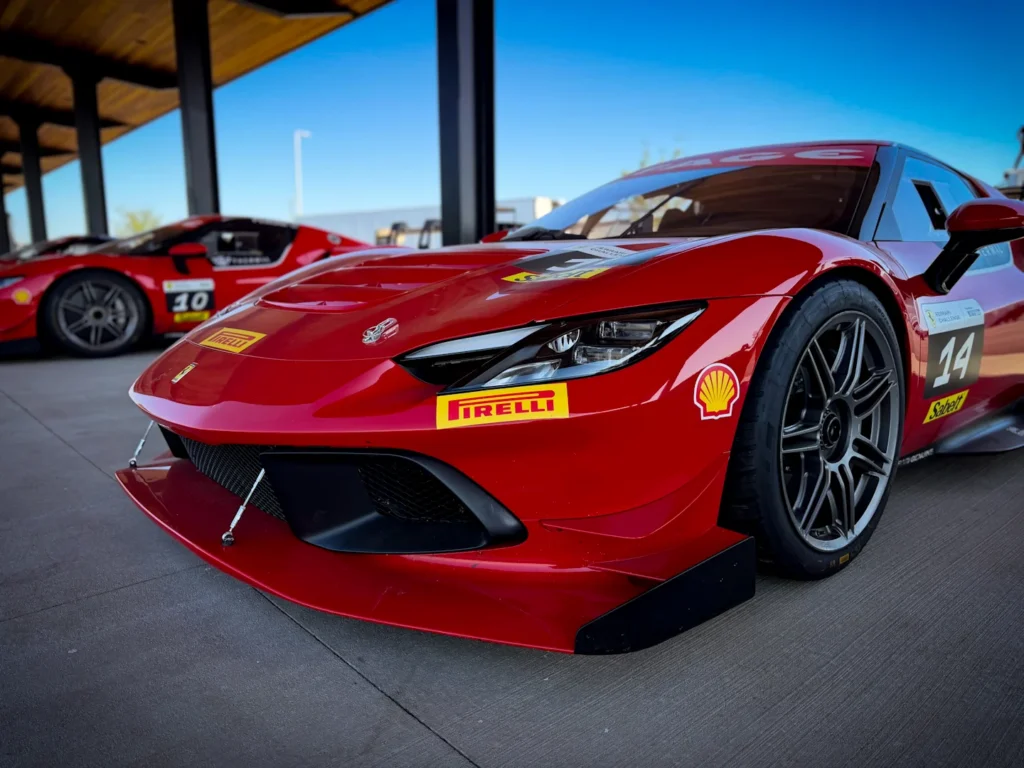
A Ferrari Corsa Pilota program and an automotive industry conference can be hosted at the Ten Tenths Motor Club trackside event venue, but the coffee operation behaves completely differently. The first creates demand across a full day driving program. The other generates concentrated peak demand at registration, scheduled breaks and keynote transitions.
Activations can have roughly the same number of attendees and require a completely different equipment setup, staffing model and menu.
TL;DR
Guest count is attendance, not a guaranteed drink count. For a standard two-hour event, Roaming Spirits Coffee typically recommends one mobile espresso bar for approximately 100 guests, but the event schedule can change that recommendation.
A 100-person reception spread across two hours is a different operation from 100 conference attendees released for a 20-minute break.
Roaming Spirits Coffee plans around approximately 40–45 handcrafted 10-ounce or 12-ounce double-shot lattes per hour for a highly skilled barista operating commercial espresso equipment.
Drinks-per-hour claims are not comparable unless drink size, espresso recipe, staffing and equipment are comparable.
The coffee format should follow the event. Trucks work when guests naturally reach the vehicle; portable espresso bars work when coffee needs to meet guests inside the venue.
Hosted espresso catering is a staffed hospitality service. A defined-quantity product, such as Roaming Spirits Coffee’s on-site Bottled Latte Bar, is a different purchasing model.
The best vendor comparison is not simply ‘Can you serve 200 people?’ It is ‘Have you executed an event that behaves like ours?’
In This Article
Topics covered in this article
- Is guest count the same as drink count?
- Why can equal guest counts need different service?
- How many lattes can one barista make per hour?
- Why aren’t drinks-per-hour claims equivalent?
- Does commercial espresso equipment matter?
- How do hosted service and defined quantity differ?
- Coffee truck or mobile espresso bar?
- Why does event-production experience matter?
- What has RSC learned from large events?
- How should coffee catering proposals be compared?
Is Guest Count the Same as Drink Count for Coffee Catering?
No. Guest count is attendance. Drink count is consumption. They are not interchangeable numbers.
If 100 guests attend an event, that does not mean the host has purchased 100 lattes. Some guests may never approach the espresso bar; others may return for another drink. More importantly, attendance does not tell us when those orders will happen.
For hosted espresso service, Roaming Spirits Coffee uses guest count to understand event scale, then looks at the schedule and service environment to determine how the coffee operation needs to function.
Guest count helps establish the size of the audience, but the schedule and service environment determine how the coffee bar needs to operate.
Why Can Two Events With the Same Attendance Need Different Coffee Service?
Consider two events with 100 attendees. At a two-hour office employee event, attendees will arrive at the coffee cart throughout the event window. The typical engagement pattern is an initial 45-minute rush followed by a steady stream for remainder of time. At a conference, a keynote may end at 10:15 a.m., sending most attendees to the coffee cart for a 20-minute networking break. The headcount is the same, but the service requirement is not.
We see this in our own work. Ferrari Corsa Pilota distributes hospitality across a full day driving program as guests move through the experience. An automotive conference or festival creates concentrated service periods around registration, scheduled breaks and agenda transitions. Headcount tells us how many people are expected to attend. The event timeline tells us how to structure the coffee catering experience.
| Event pattern | What guests do | Coffee implication |
|---|---|---|
| Reception – Corporate, Wedding, Brand Activations. | Arrive and circulate over a longer window. Less structured flow with less predictable peaks. | Demand is distributed across the service window with variable peak demand. |
| Conference – Registration, Breaks, Lunch, Networking Sessions. | Structured peak demand, higher engagement. Multiple peak demand windows. | Demand concentrates into short windows tied to the conference agenda. |
| Experiential Hospitality Program | Move through scheduled experiences | Coffee follows the program rhythm. Attendance, demand and consumption behavior vary widely. |
| Multi-day operation | Initial discovery demand. Return throughout the day/week. Order in multiples. | Consistency and sustained production matter most. Longer lines, increased demand, multi-drink orders. |
Why We Compare Event Coffee Catering to Racing
Charlotte, NC is considered the home of NASCAR and the Charlotte Motor Speedway, so the racing analogy comes naturally. Roaming Spirits Coffee provides mobile espresso service for luxury automotive events, including programs for Ferrari, McLaren, Rolls Royce and the Heritage Festival at Ten Tenths Motor Club. We are frequently asked, “aren’t all coffee carts the same thing?” As racing enthusiasts, we often explain it with a racing analogy. Consider the most popular racing events; NASCAR, Formula 1 and IndyCar. They’re all races with specific cars engineered to perform at very different track venues. They’re all incredibly fast, high-performance machines, but they’re engineered for different forms of racing. The operating environment determines what belongs on the starting grid. Mobile coffee works much the same way. A coffee truck, coffee cart, retail pop-up and mobile espresso bar can all serve excellent coffee. That doesn’t make them interchangeable. A truck’s configuration may be ideal for an outdoor event while a portable espresso bar may be the better fit inside a hotel conference or luxury showroom.
How Many Handcrafted Lattes Can One Barista Actually Make Per Hour?
Commercial espresso equipment is typically sized around peak-hour production demand rather than total daily volume. Group count affects parallel production capacity, while boiler size and steam capacity affect sustained production during service, according to Zanduco’s commercial espresso machine sizing guide.¹ In practice, finished output depends on the equipment, barista, the workflow and the guest interaction working together.
Roaming Spirits Coffee uses approximately 40 to 45 handcrafted 10-ounce hot or 12-ounce iced lattes per hour as an efficient sustained planning range for a highly skilled barista working on our commercial espresso equipment.
| Beverage Type | Our Standard |
|---|---|
| Hot latte | 10 oz, double-shot espresso |
| Iced latte | 12 oz, double-shot espresso |
| Single Cart Planning Range | Approximately 40–45 finished lattes/hour |
That benchmark is based on finished beverages, not the theoretical number of espresso shots a machine can pull. A latte requires grinding and dosing, extraction, milk preparation, ingredients, assembly and guest handoff. A skilled barista overlaps those tasks, and an efficient bar reduces unnecessary movement. Published metrics also fail to account for guest interaction with the espresso cart.
A coffee hospitality experience isn’t transactional. Guests review an event menu, engage in conversation with the barista and create a moment of connection rather than ordering at a counter and immediately stepping aside to a pickup area. This is what turns coffee catering into as much of an art as a science.
Why Don’t Drinks-Per-Hour Claims Always Mean the Same Thing?
Because the word “drink” does not describe a standardized beverage.
Roaming Spirits Coffee’s standard latte is a 10-ounce hot or 12-ounce iced double-shot beverage. Another operator may serve an 8-ounce beverage by splitting a double espresso extraction between two 8-ounce cups. The second workflow can produce two counted drinks from the same extraction that produces one Roaming Spirits Coffee latte. Neither specification is inherently right or wrong, but they are not equivalent production measurements. A drink or guest count based quote without a beverage specification isn’t a meaningful comparison.
| When comparing output, ask | Why it matters |
|---|---|
| What size is each drink? | A smaller beverage can be created faster when speed is the main objective for coffee service. |
| How many espresso shots are in it? | Single- and double-shot beverages are not equivalent. |
| How many baristas produce the quoted number? | Staffing changes finished output. 2 baristas on 1 bar produce a higher volume of drinks due to workflow optimization. |
| How many machines/service points are included? | Adding additional equipment/staff/carts increases output. |
Does the Espresso Machine Matter for Event Coffee Catering?
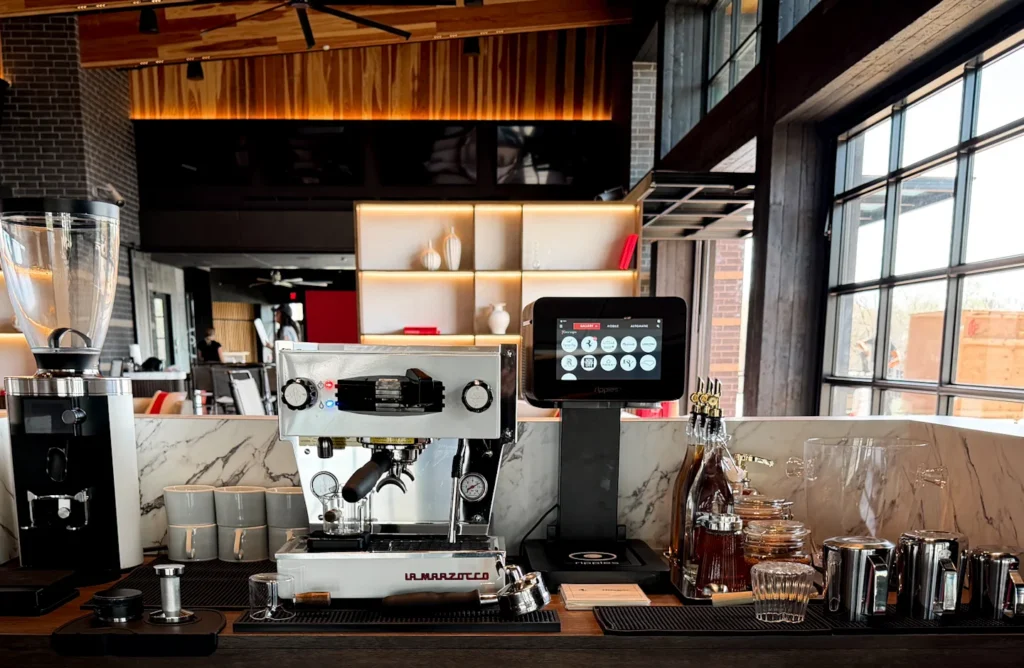
Yes, particularly during sustained or concentrated service. Roaming Spirits Coffee operates La Marzocco commercial espresso machines designed for professional café service and repeated output in high volume settings. Our teams routinely use multiple La Marzocco espresso machines for high volume output. Our experience over full day and multi-day activations producing over 500 lattes a day for the Cirrus Jet owners lounge is real world data validating our equipment choice.
Many consumer, prosumer and commercial machines can make an excellent latte. The better question isn’t simply which machine is on the cart. It’s what happens after drink 50, drink 150 or drink 250? Steam capacity, boiler recovery, grinder performance and the plumbing all matter.
Equipment alone still does not solve the event. An expensive machine inside a poor workflow can create bottlenecks. A skilled barista in an efficient commercial setup can keep extraction, milk preparation, assembly and guest handoff moving in parallel.
The machine sets part of the production capacity. What reaches the guest also depends on the grinder, barista, plumbing and bar workflow working together.
Is Coffee Catering the Same as Purchasing a Certain Number of Drinks?
Before comparing proposals, establish which service model is being quoted.
Roaming Spirits Coffee staffed mobile espresso bars operate as hosted hospitality for a contracted service period. We bring the mobile bar, professional equipment, staff it and serve handcrafted beverages while the bar is operating. That differs from both a consumer-pay pop-up and a predetermined beverage quantity.
| Service model | What the client is booking |
|---|---|
| Mobile Espresso Bar | Hosted, staffed hospitality during a contracted service period. Professional barista using an espresso machine on-site to produce specialty coffee beverages. |
| Coffee Cart | Format description, not necessarily a service model. A coffee cart may describe a mobile espresso bar, drip coffee service, cold brew service or another beverage setup. The term alone does not define what is being served or how service is structured. |
| Consumer-pay pop-up | Coffee, matcha, boba, lattes on tap. The key is the individual guest pays or if offered in a catering setting the host is billed for all guest orders on a running tab. |
Coffee Truck or Mobile Espresso Bar?
The first question should not be ‘Do we want a truck or a cart?’ It should be ‘Where will our guests be, and where does coffee need to meet them?’
Neither format is universally better. The right choice depends on where guests are and how coffee needs to fit into the event. A truck outside a hotel may have enough production capacity for 100 attendees, but if those attendees have only 20 minutes between sessions, leaving the ballroom, navigating the hotel, reaching the truck and returning can make the format itself the problem.
| Format | Often fits when… | Potential mismatch |
|---|---|---|
| Coffee truck | Guests naturally have vehicle access; outdoor festivals, campuses and parking-lot activations | Coffee is needed deep inside a venue or during a short indoor break |
| Mobile espresso bar / coffee cart | Coffee needs to operate inside conference, retail, showroom or hospitality spaces | The event is designed around a mobile café experience. This can be a cart or a custom event bar. |
Why Does Event-Production Experience Matter?
Venue and event-production experience matter as much as the coffee being served.
Espresso production is only one part of coffee catering. Before the first latte is served, the operation may need to account for loading docks, freight elevators, security, arrival windows, dedicated power, floor plans, installation deadlines, other vendors, brand standards, weather and breakdown requirements.
Roaming Spirits Coffee has completed day-before installations, coordinated dedicated electrical power for corporate programs, installed espresso hospitality inside luxury automotive showrooms, worked around conference agendas and built temporary coffee operations where the bar, equipment, water and supporting infrastructure all had to arrive with us. A coffee cart in the wrong location, without adequate power, arriving through the wrong entrance at the wrong time becomes an event problem very quickly.
What Have Large Events Taught Roaming Spirits Coffee About Coffee Catering Capacity?
PGA Championship – Broadcast Compound: Sustained Production
During the 2026 PGA Championship broadcast operation, Roaming Spirits Coffee served more than 4,000 handcrafted beverages during a week-long catering operation. What mattered most was repeated execution, not a single maximum-output hour. Morning and afternoon behaved differently, equipment had to recover, workflow had to remain efficient and the operation had to perform again the next day.
EAA AirVenture Oshkosh: Two Operations Inside One Event
At EAA AirVenture Oshkosh, Roaming Spirits Coffee operated two separate aviation hospitality coffee programs and served more than 6,000 handcrafted drinks. The Cirrus Jet Owners Lounge and DAHER VIP Owners Lounge had different guests, service schedules, physical environments and hospitality requirements. Even within the same airshow, they required different coffee operations.
Luxury Automotive Events: Service Must Belong in the Room
RSC’s luxury automotive work includes programs for Ferrari, McLaren, Rolls Royce and the Heritage Festival at Ten Tenths Motor Club. In premium hospitality, capacity is not only about how quickly drinks can be produced. The service also must fit the experience it was hired to support. Brand aesthetics, equipment, menu and the hospitality experience distinguish coffee catering from hiring a coffee cart.
How Should You Compare Two Coffee Catering Proposals?
Two proposals can both say ‘mobile espresso bar for 100 guests’ without representing equivalent services.
| Compare | Ask |
|---|---|
| Beverage | What size are hot and iced drinks? Single, split or double shot? What is on the menu? |
| Production | What does the drinks-per-hour number count? |
| Equipment | What espresso machine and grinder will be at the event? Is the machine plumbed? |
| Staffing | How many people are producing beverages? Who is supporting the team on-site? |
| Service model | Hosted hospitality, defined quantity or consumer-pay? |
| Installation/Insurance | Who manages insurance, power, water, load-in and breakdown? |
| Experience | Have you executed an event that is structured like ours? |
A company does not need to have worked your exact event before. It should be able to explain why the service it recommends fits the event you are producing. Sometimes two vendors are offering comparable services at different prices. In other cases, the proposals are not actually quoting the same service.
What Should a Coffee Caterer Ask You?
You don’t need to know how many espresso machines or baristas your event requires. That’s what you’re hiring the coffee caterer to determine.
Event location and venue
Expected attendance
Event agenda and timeline
When coffee should be available
What happens immediately before and after coffee service
Where guests will be when service begins
Expected bar location
Indoor or outdoor conditions
Insurance, loading logistics and security requirements.
For a conference, complex venue or multi-day activation, an experienced coffee catering partner will guide you through the logistics. They act as your hospitality partner, helping ensure the coffee service integrates seamlessly into your run of show.
Frequently Asked Questions
How much coffee service does an event need?
It depends on the event schedule, guest behavior, service duration, beverage specifications, venue and bar location. For a standard two-hour event, Roaming Spirits Coffee typically recommends one mobile espresso bar for approximately 100 guests.
Is guest count the same as drink count?
No. Guest count represents attendance, not a predetermined number of beverages. Hosted espresso catering provides staffed hospitality during a contracted service period.
How many lattes can one barista make per hour?
Roaming Spirits Coffee uses approximately 40–45 handcrafted 10- or 12-ounce double-shot lattes per hour as an efficient sustained planning range for a highly skilled solo barista using commercial espresso equipment.
Does the espresso machine matter?
Yes. During sustained or concentrated service, steam capacity, boiler recovery, grinder performance, plumbing and workflow all affect finished-beverage production.
Is a coffee truck better than a coffee cart?
Neither is universally better. Trucks work well when guests naturally reach the vehicle. Portable espresso bars work well when coffee needs to operate inside the venue and within the guest journey.
What should I compare between coffee caterers?
Compare beverage specifications, production claims, commercial equipment, staffing, service model, venue requirements and experience with events that have similar operational demands.
The Finish Line
There’s no one-size-fits-all race car, and there isn’t a universally preferred mobile coffee format. F1, NASCAR and IndyCar are designed around different operating environments. Coffee catering works the same way. After thousands of service hours across corporate conferences, luxury automotive events, retail activations, weddings and multi-day national hospitality programs, we keep coming back to the same point:
Making great coffee is one skill. Making great coffee catering work inside a live event is another.
Look at the event first. Then build the coffee operation it requires.
The event determines the race. The race determines the car.
Technical References
1. Zanduco. “1, 2, or 3 Group Espresso Machine? The Real Math Behind a US Café Buy.” Commercial Espresso Machine Size Guide. https://www.zanduco.com/us/resources-and-articles/espresso-machine-group-size-guide.html